A brief note on parity violation
I. Weak Nuclear Force
There are four fundamental interactions in nature — gravitational force, electromagnetic force, strong nuclear force and weak nuclear force.
Weak nuclear force (also called “weak interaction”) is the mechanism of interaction between subatomic particles (particles smaller than atoms) responsible for the radioactive decay of atoms, which participates in nuclear fission and fusion.
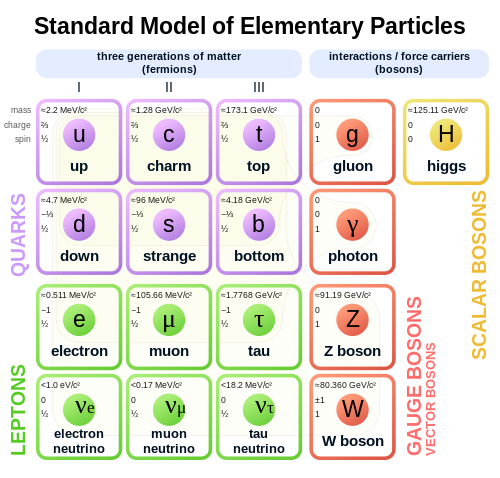
Different from the other three interactions, the weak force is transmitted through exchanging three types of force carriers, namely, ${W^+}$, ${W^-}$ and ${Z}$ Gauge bosons. The masses of these bosons are greater than that of a proton or neutron, which is consistent with the short range of the weak force. The fermions (subatomic particles that follow Fermi-Dirac statistics) involved in such exchanges can be either elementary (e.g. electrons or quarks) or composite (e.g. protons or neutrons).
II. Conservation Law and Noether’s Theorem
In physics, a conservation law states that “a particular measurable property of an isolated physical system does not change as the system evolves over time”. Noether’s theorem states that “every continuous (differentiable) symmetry of the action of a physical system with conservative forces has a corresponding conservation law”. For example, temporal translation symmetry, spatial translation symmetry and rotational symmetry, respectively, correspond to conservation of energy, conservation of linear momentum and conservation of angular momentum.
III. τ-θ Puzzle and Parity Violation
A parity transformation is the flip in the sign of one spatial coordinate, which transforms a physical phenomenon into its mirror image. It is a discontinuous symmetry. In three dimensions,
$$(x, y, z) \rightarrow (-x, -y, -z)$$
If a physical process remains unchanged in the inversion, we say it complies to conservation of parity.
At first, scientists believed that all the four fundamental interactions of elementary particles are symmetric under parity transformation. Then here came the problem known as τ-θ puzzle. Two different decays were found for Kaons (K mesons, τ and θ) into pions (π).
$$θ^+ \rightarrow π^+ + π^0$$
$$τ^+ \rightarrow π^+ + π^+ + π^-$$
The intrinsic parity of the pion is $P=-1$, and the parity is a multiplicative quantum number. Therefore, the two-pion and three-pion final states were assumed to have different parities ($P=+1$ and $P=-1$ , respectively ). It was then thought that the initial states should also have different parities, and thus be two distinct particles. However, with other precise measurements, the characteristics of each such as mass, lifetime, charge and spin are totally identical, indicating that they are the same particle. But how can a single particle have two different parities at the same time?
In 1956, Tsung-Dao Lee and Yang Chen-Ning put forward the question:
What if the weak interaction doesn’t follow parity conservation (P-conservation)?
And surprisingly, they found no experiment had ever demonstrated that parity is conserved in weak interactions. This idea is what later we call parity violation and was proved not long after it was proposed.
IV. Wu experiment
In the summer of 1956 Lee and Yang reached Chien-Shiung Wu, who was an expert on beta decay spectroscopy. At their request, Wu decided to begin what she thought a potential breakthrough experiment by testing the directional properties of beta decay in Co-60.
In the experiment, she monitored the decay of cobalt-60 ($^{60}Co$ , an unstable isotope of cobalt that decays by beta decay to an excited state of the isotope $^{60}Ni$ ) atoms that were cooled to near absolute zero and aligned by a uniform magnetic field. Using a magnetic field to orient the Co-60 nuclei in one direction and using a reverse magnetic field to orient the Co-60 nuclei in an opposite direction, she placed the detectors in opposite hemispheres with respect to the nuclear spin.
Wu found an extinct beta-emission asymmetry between the two directions of nuclear spin polarization, that was, the pattern of electron emission differed in these two conditions, which was sufficient to show that weak interaction does violate the parity conservation. She also reported that “the emission of beta particles is more favored in the direction opposite to that of a nuclear spin”.

Although the results greatly surprised many physicists, who had previously regarded parity as a symmetry that applied to all forces of nature and reacted with disbelief at the consequences, further experiments confirmed the original results of Wu’s, and P-violation was firmly established.
V. Supplementary
In 1957, Lee and Yang received the Nobel Prize in physics for originating the idea of parity nonconservation. But Wu, who designed and carried out the experiment that tested the conservation of parity, was not honored until 1978, when she was awarded the Wolf Prize.
On October 18, 2025, Yang died at the age of 103.